word salad vs wordle
Word Salad vs Wordle: How the Two Daily Word Games Differ
Word Salad vs Wordle compared: how the swiping themed grid differs from the six-guess five-letter game, with mechanics, hints and a full FAQ.
Word Salad vs Wordle: How the Two Daily Word Games Differ
Word Salad and Wordle both arrive as a single small puzzle each day, which is exactly why players keep comparing them. The Word Salad vs Wordle question is really a comparison of two puzzle lineages: Wordle is a guessing game built on deduction and elimination, while Word Salad is a tracing game built on recognition and category thinking. This page walks through what each game actually asks you to do, where the mechanics diverge, and how to tell in five seconds which kind of puzzle you are looking at.
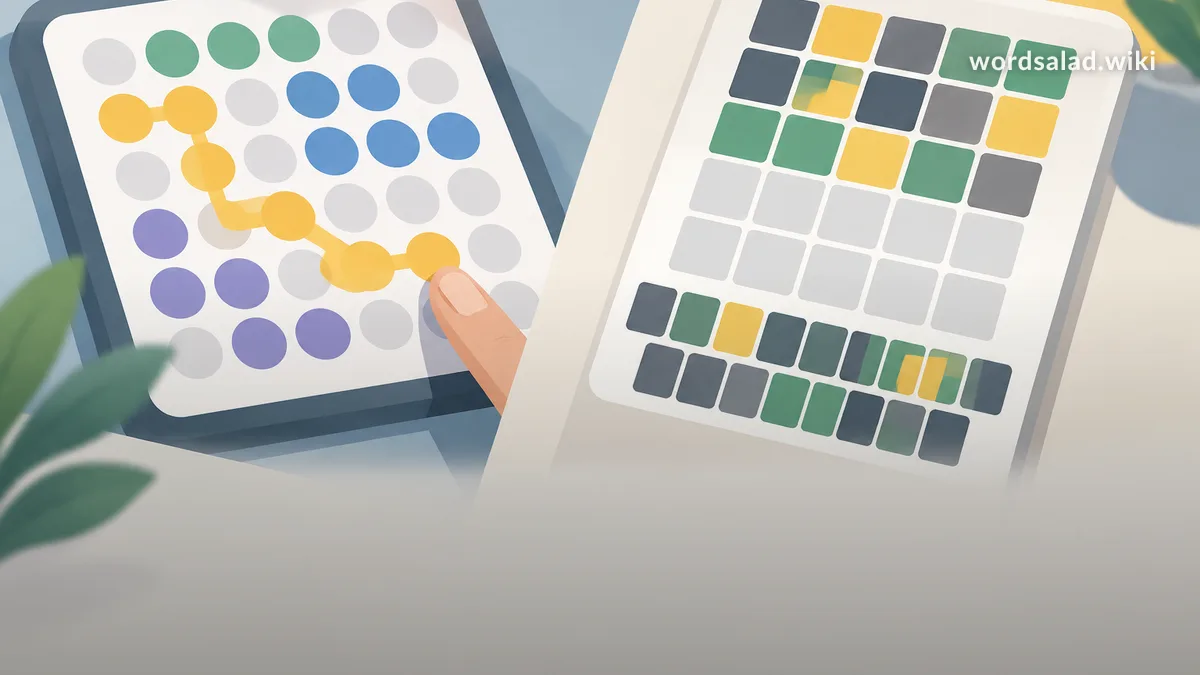
{{IMG_0:Two smartphone screens side by side, left a letter grid with a curved swipe trail through highlighted tiles, right six empty guess rows with green yellow and gray letter tiles.}}
What is the fastest way to tell Word Salad and Wordle apart?
Wordle gives you six attempts to guess one hidden five-letter word, answering each attempt with green, yellow, or gray tiles. Word Salad gives you a themed grid of letter tiles and asks you to swipe through several hidden theme words until the solved letters fall away. One is guess-and-deduce; the other is find-and-clear.
If you remember only one thing, remember the input: Wordle is typed, Word Salad is swiped. Everything else in this comparison follows from that single difference.
How is Word Salad different from Wordle?
Wordle: one secret word, six guesses
Wordle presents a single row of five empty boxes and a keyboard. You submit a five-letter word, and the game colours each tile green, yellow, or gray depending on whether that letter is correct and in the right position, correct but misplaced, or absent from the answer entirely. Six rows is the whole budget, so the real skill is information management: choosing opening words that eliminate as many letters as possible, then narrowing the remaining candidates.
Word Salad: one themed grid, several hidden words
Word Salad starts from the opposite direction. Instead of hiding one answer, it hides several related words inside a grid of letter tiles. You swipe across adjacent tiles to trace a word; when you find one, its letters clear and the remaining grid opens up. The words inside a single grid belong to a shared theme or category family, so the second layer of the puzzle is noticing the pattern that connects them.
Side-by-side comparison
| Wordle | Word Salad | |
|---|---|---|
| Published by | The New York Times | Bleppo LTD |
| Core task | Guess one hidden five-letter word | Trace several hidden theme words in a letter grid |
| Input | Type letters and submit a guess | Swipe across adjacent tiles to trace a word |
| Feedback | Green, yellow, and gray tiles show letter placement | Solved words clear out of the grid as you find them |
| Puzzle shape | Single word, six attempts | Grid of theme words plus a shared category insight |
| Daily cadence | One puzzle per day | One daily puzzle, tracked by puzzle number |
| Hints | No in-game hint button; deduction only | Graduated, spoiler-light hint resources |
| Back catalogue | The official page focuses on the current puzzle | Past grids recorded in a dated archive |
The Wordle column follows the mechanics documented on the official New York Times game page; the Word Salad column follows the game's App Store listing and the swiping mechanic described in the official game itself.
Are Word Salad and Wordle made by the same developer?
No. Wordle is published by The New York Times, which took over the game originally created by Josh Wardle. Word Salad is a separate daily puzzle from Bleppo LTD. The two are unrelated projects that happen to share one habit: a finite, once-a-day word challenge you can finish in a few minutes.
Because they come from different studios, you should not expect shared accounts, shared streaks, or a shared puzzle calendar. Streaks, hint resources, and archives belong to each game separately, and the puzzle numbering in one has nothing to do with the numbering in the other.
What does a typical daily session look like in each game?
The Wordle session
You open the page, type a starting word, and read the colours. From there you usually need three or four more guesses, reasoning about which letters are confirmed, which are excluded, and which positions are still open. The session ends when you solve the word or run out of rows.
The Word Salad session
You open the puzzle and scan the grid for familiar letter pairs and likely starting tiles. The first few words often come quickly, because your eye catches common patterns; the last one or two force you to work around the gaps left behind by cleared tiles. Because solved letters disappear, the grid becomes both emptier and more awkward as you go, and that is where the difficulty curve of a given day lives.
Word Salad puzzles are tracked by puzzle number, which makes it easy to refer back to a specific grid when comparing notes with other players. The wiki keeps a dated record of past grids in its archive.
{{IMG_1:A close-up of fingers swiping diagonally across a phone screen covered in letter tiles, with three tiles highlighted and two tile spaces left empty.}}
Do the two games handle hints the same way?
Not really. Wordle has no in-game hint button, so if you are stuck you either keep guessing or look up outside help, which usually means spoiling part of the answer.
Word Salad's help culture works differently, because a grid gives you more room to be nudged without being told the solution. A hint can point at a category, a word length, or a starting tile without revealing the full set of words. The wiki gathers this kind of graduated help on its answer pages, where hints are grouped by how much they reveal, and the how-to-play guide explains the swiping mechanic itself for anyone losing words to a mis-traced path.
If you want the rules with zero spoilers, start with basics; if you want a nudge toward today's grid, go to the answer pages instead.
Is Word Salad a "game like Wordle"?
It belongs to the same broad family — daily word puzzles with one shared puzzle for everyone and a streak worth protecting — but it feels closer to a word search than to a guessing game. When players search for "games like Wordle", they usually mean one of three things:
- a once-a-day puzzle with a streak to maintain
- a short session that fits inside a coffee break
- a social layer, where comparing results with other players is part of the fun
Word Salad satisfies all three, while asking for a different skill: spotting patterns inside a grid rather than eliminating letters from a candidate list.
Which game suits which kind of player?
Pick based on the skill you enjoy using, not on difficulty claims.
- If you like deduction, letter-frequency reasoning, and the satisfaction of narrowing a word down from a broad guess, Wordle's loop will feel natural.
- If you like scanning, pattern recognition, and the small "aha" of realising that six scattered words are all, say, things you would find in a kitchen, Word Salad's grid will feel more rewarding.
- If you like switching modes, there is no rule against playing both. Each takes minutes, and they exercise different parts of your vocabulary.
Where can you play Word Salad and Wordle today?
Word Salad is free to play at wordsalad.online and is also distributed as a mobile app on iOS and Android by Bleppo LTD. Wordle is played on The New York Times games page. If you are starting with Word Salad, read the how-to-play guide first so the swipe gesture clicks immediately, then work through today's grid.
Frequently asked questions about Word Salad vs Wordle
Is Word Salad the same as Wordle?
No. They are different games from different publishers. Wordle is a typing-based guessing game from The New York Times; Word Salad is a swiping, grid-based puzzle from Bleppo LTD. They share a daily format, not a mechanic.
Does Word Salad use five-letter words like Wordle?
Not exclusively. Word Salad is built around theme words grouped by category, so the puzzle is not restricted to a single five-letter answer the way Wordle is. Word lengths vary from one grid to the next.
Do I get six attempts in Word Salad?
No, because attempts are not the frame at all. You are not guessing and being graded; you are finding words and clearing them. A grid is finished when every hidden word has been traced.
Can I play Word Salad in a browser, or only on a phone?
Both. Word Salad runs in a browser at wordsalad.online and is also available as an app on the official iOS and Android stores, so a phone is convenient but not required.
Does Word Salad have an archive of past puzzles?
Yes. Because puzzles are numbered, past grids can be recorded and revisited. The wiki logs them by date in the archive so you can look up a specific day.
What should I do if I get stuck on a Word Salad grid?
Use graduated hints rather than an instant answer. Category clues and starting-tile nudges usually unstick a player without spoiling the whole grid, which is how the answer pages are organised.
Is Word Salad harder than Wordle?
Neither is harder in general terms; they test different skills. Wordle rewards logic and vocabulary recall under a hard attempt limit, while Word Salad rewards visual scanning and category reasoning with no attempt limit at all.
How to check the mechanics yourself
If a rule in this comparison ever looks out of date, verify it against the official Word Salad App Store listing and the official Wordle page from The New York Times, since those are the live sources for each game's current behaviour. Word Salad Wiki is an independent, fan-made resource and is not affiliated with or endorsed by Bleppo LTD or The New York Times. When either game changes a rule, the official version wins, and this page is corrected to match.